Originally posted by The Red Phoenix at http://theredphoenixapl.org/2011/11/27/the-idf-abuse-of-palestinian-children/
Israel’s system of military law for Palestinian children has become a major issue, as our Middle East correspondent John Lyons reported in The Weekend Australian Magazine. Here he continues his investigation of the military court system, looking at the effect detention can have.
Fadia Saleh runs eleven rehabilitation centres in the Palestinian territories, or West Bank, on behalf of the YMCA which deal with the effects of detention on children.
“Usually the children isolate themselves, they become very angry for the simplest reasons, they have nightmares,” she says.
“They have usually lost trust in others. Usually they don’t have friends any more because they think their friends will betray them.
“There is also a stigma about them other children and parents say ‘Be careful being seen with him, because the Israeli soldiers will target you.”‘
The brutality of some recent cases has surprised even professionals.
Fadia Saleh said: “Last week one boy described to me how dogs were present in the army jeep. In those jeeps you have chairs on each side and an empty space in the middle the children are put there, on the floor. Sometimes soldiers step on them.
“Every time the child moved, one of the dogs would bite him. When he arrived at the interrogation centre, his arm was bleeding. It was a short trip but he felt like (it was) a year.”
Human rights group Defence of Children International (DCI) has documented three cases where children being interrogated by Israeli officers were given electric shocks by hand-held devices to force them to confess.
The head of DCI Palestine, Australian lawyer Gerard Horton, has claimed there is one interrogator in the Jewish settlement of Gush Etzion “who specialises in threatening children with rape.”
The Weekend Australian Magazine reported that there are many other allegations: a boy being kept in solitary confinement for 65 days; other boys being kept in solitary confinement with the lights on 24 hours a day; a seven-year-old boy taken for interrogation in Jerusalem who says he was hit during questioning.
The Israeli Defence Forces (IDF) told The Weekend Australian Magazine that there had been 2766 incidents of rock throwing in the West Bank, which is under Israeli military occupation, in the first 11 months of 2011 against either IDF soldiers or passing cars.
Israeli police also say a crash in September which killed a man and his infant son may have been caused by a rock hitting their car.
Israel’s international spokesman Yigal Palmor said: “There are many things that need to be improved. This is a general problem which derives from the fact that the West Bank is under military jurisdiction and military law and there is obviously a discrepancy between the civil code in Israel and the military law in the West Bank.
“That’s the root of the problem. But extending fully Israeli law to the West Bank would be tantamount to annexation.”
Fadia Saleh, from the YMCA’s rehabilitation program, says both physical and psychological torture are used.
The trauma, she says, is caused by the arrest and because children realize that their parents are powerless to do anything.
Solitary confinement complicates the child’s problems.
Fadia Saleh says occasionally in her line of work something makes her smile.
“One child was being interrogated and was asked for names of other children who had thrown stones and he gave some names,” she says.
“The soldiers kept saying ‘That’s not enough, give us more.’ The child began inventing names. The soldiers went around Silwan (East Jerusalem) looking for the children and couldn’t find them. Then they began looking for the boy to ask where all these children lived.
“So the boy had to go from house to house so the soldiers would not find him.”
A recent British delegation which visited the West Bank asked the children about a legal right to remain silent.
“The children asked ‘What do you mean?”‘ says Fadia Saleh.
“I tried to explain and their view was ‘Come on, what are you talking about? They (the Israeli soldiers) didn’t have the time, they were hitting us”‘.
Head counsellor at the YMCA rehabilitation centres, Mona Zaghrout Hodali, says on some days in Jerusalem up to 20 children are detained.
“Many children in the Jerusalem area are under house arrest,” she says.
One 13- year-old child would not talk to his parents because his father and mother had told him ‘You are safe, they cannot get you in the house’ but they did come into the house and took him. He said to his parents ‘you cannot protect me’. The boy began defecating without warning, from the trauma.
“I remember the case of a child from Jerusalem,” says Ms Hodali.
“To torture him they put him behind a door and then people would come into the room and hit him on purpose.
“Another boy, 15 from Hebron, was with his mother picking olives in a field. Soldiers came and pushed him to the ground and started beating him.
“They kept him for one week without a claim (charge.) When he came out his mother said ‘I don’t know him he doesn’t want to go to school, he can’t sleep, he walks around the house at nights.’
“We have children who have spent two years or three years, in prison. The Israeli army have things called administrative detention orders and they can keep rolling these over.
“I still deal with one case in Jenin where the boy was shot in the spinal cord. They ( the soldiers) took him to the hospital where he was in a coma for five days . He woke up in hospital, cuffed and paralysed.
“They knew he was paralysed because he’d been shot in the spinal cord. They took him straight from hospital to jail in a wheelchair.
“He spent more than six years in jail. He went in when he was 19 and came out when he was 25.”
Ms Hodali said when he got out of jail he said he wanted to go to a doctor and the doctor said he had came too late if he had come earlier he could have helped him walk, at least on crutches.
Ten-year-old Mahmoud A is a case study of the treatment of some Palestinian children by the Israeli military. He lives on the frontline of the Israeli-Palestinian conflict.
His home is in the Palestinian village Beit Ummar, in the West bank. On February 18, Mahmoud, then nine, was playing with other children in front of his house.
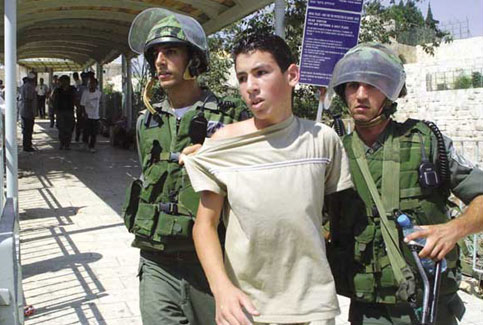
Suddenly, according to his family, Israeli soldiers began chasing the children they grabbed Mahmoud but several of the other children ran away.
One soldier told Mahmoud’s parents that a boy in a blue shirt had thrown stones at an army jeep and they believed he had been with the group.
The soldiers began taking Mahmoud away when his father grabbed his arm. The father says a soldier got him in a headlock which made him let go of his son. The soldier then put the boy onto his back and took him away.
Mahmoud’s mother, Rana, said one of the soldiers told her : “We are capturing him until you bring us the other boy (in the blue shirt)”.
One of Mahmoud’s relatives drove by and saw him in the vehicle. He stopped to argue for his release.
Rana says the four soldiers made the relative get out of his car before beating him with sticks. The boy was blindfolded and driven away. “I was crying and saying in Arabic that I want to go home but I don’t know if he knew what I was saying,” Mahmoud said.
Mahmoud says he was made to sit in the sun, blindfolded, and a soldier told him: “You threw stones and you know people who threw stones give us their names.”
Mahmoud says when he said this was not true the soldier hit him in the face “four or five times”.
The interrogation lasted for hours.
We saw the boy’s situation first hand. The day The Australian visited his village recently the army had closed off the entrance which meant we could not drive in.
So Mahmoud walked to meet us but as we were walking past the checkpoint one soldier shouted “Mahmoud!” He moved towards, Mahmoud who broke into tears. The locals told the soldiers he has been doing nothing wrong.
“He threw stones,” one of the soldiers replied. In the rough justice of these parts, it appears Mahmoud has been tried and convicted for something he did not do.
It appears that between locals arguing with the soldiers and our presence the soldiers decided to let him go.
His mother says that since he was taken away Mahmoud will not go outside the house after dark. She says his younger brother, Nour, is worried the soldiers will take him away too.
As we sat talking on the family’s balcony, Nour frequently looked towards the soldiers in the guard tower which looks down over the village.
It is not uncommon for Israeli soldiers to fire tear gas into the village in response to stone throwing.
Rana says she closes her windows to try and prevent gas coming in.
But the women in the village told us that after years of tear gas they fear it maybe affecting some women in the village who are finding it difficult to become pregnant.
The village is also a flashpoint between Palestinians and Jewish settlers. Villagers say the settlers recently went to a Palestinian shop and smashed the pots being displayed outside.
The horror of this small village is being replicated across the West Bank.