ORIGINALLY POSTED AT HTTP://BIT.LY/IDRIDM
SPECIAL TOPIC
While the world is commemorating the victims and atrocities of WorldWar II, Israel celebrates it’s “Independance” and commemorates “HaShoah” (The Holocaust), the world is in silence as it is concerned to “Al Nakba” (The Catastrophe) which hunts Palestinians now for 63 years and ongoing… even today. But, for Palestinians no memorial for Israel even made it forbidden to commemorate the Nakba itself. This Silence of the world on these atrocities itself and even ignorance about a specific Israeli law about the so called ” Nakba Law ” encourages even more racism…
When not silenced in media, Israeli’s hasbara (propaganda) machine has endless and tireless reasons why it commits demoitions.
But it is quite simple, forget all details. For there are no legitimate reasons for these crimes it is about just 1 thing: ethnic cleansing. The zionist plan implicates ethnic cleansing of Palestine from the med to the River Jordan a “Greater Israel”, no exclusions.
While media covers now and then – but only in the mid-east or if you research well – the structural demolitions in the West-Bank, the devastation of bombings of Gaza, the ongoing demolitions of homes in the Negev, belonging to Bedouin remains on to the headlines… Al Araqib has been demolished for the 8th time, the 9th time, the 10th time, etc etc.
And again, the world is in ignorance and silence, while Israel is committing this ethnic cleansing now on daily basis on Palestinians, even in the desert.
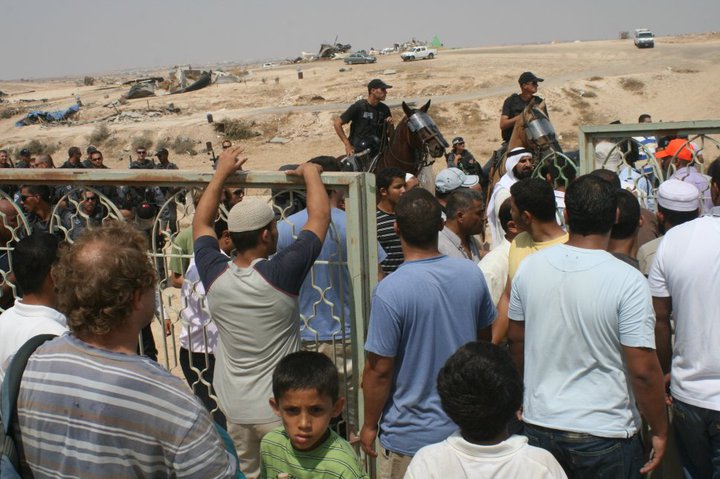
Because pictures say more than a thousand words, below an impression of the violence, the devastation, the way “Israel” pushes it’s troops, soldiers, police, trucks, caterpillars, bulldozers, horses and materials into bedouin villages, how they destroy and demolish, violate and even wound people, and finally leave the homeless bedouin again… time after time again.
It is about time, these atrocities are stopped by the world, so share the word and the pictures.
More information:
- An extensive map of destroyed and even vanished, leveled down to earth andEthnically Cleansed villages inside “Israel “can be found here.
- For a description of each village, for testimonies, videos, pictures and resources:Tracing all that remains since Nakba
- For more information and news updates about the structural ethnic cleansing by Israeli Occupation : Special Topic: Ethnic Cleansing
- For activism go to the website of a group of concerned Arab and Jewish residents of the Negev : Dukium
Background of the Negev Bedouin
Before 1948, it is estimated that 65,000 to 90,000 Bedouins lived in the Negev area (Falah 1989).
The main source of livelihood for this semi-nomadic population was cattle, herds, rain-fed agriculture, and commerce (Yiftachel 2004; Meir 1997). During Israel’s War of Independence in 1948, 80 to 85 per cent of the Naqab Bedouins population became refugees. Like other indigenous peoples, the Naqab-Negev Bedouins underwent forced relocation – the 11,000 that remained inside Israel’s borders were moved in the 1950s and 60s from their ancestral lands into a restricted zone called the Siyag (closure), located in the northeastern Negev and known for its low agricultural fertility (Hamdan 2005; Yiftachel 2004).
This area constituted only 10 percent of the Bedouins land prior to 1948 (Abu Sa’ad 2004). Joining the six tribes already residing in this area were twelve additional tribes from various areas of the Negev. Because no permanent buildings (stone or concrete) were permitted by the authorities in the Siyag, most residents were forced to erect shacks and tents.
The Negev Bedouins, like the rest of the Arabs remaining within Israel’s borders, lived under military rule until 1966. During this time, Bedouin life was dramatically transformed: “From controllers of the desert region, they became fringe dwellers of a growing, modernizing Beer-Sheva city region” (Yiftachel 2004, p. 12). With less space for agriculture and grazing, their source of livelihood was disrupted. In addition, because of restrictions imposed by the military government, they were not permitted to compete with the Jewish labor market of the new Israeli State.
The Negev Bedouins, like the rest of the Arabs remaining within Israel’s borders, lived under military rule until 1966. During this time, Bedouin life was dramatically transformed: “From controllers of the desert region, they became fringe dwellers of a growing, modernizing Beer-Sheva city region” (Yiftachel 2004, p. 12). With less space for agriculture and grazing, their source of livelihood was disrupted. In addition, because of restrictions imposed by the military government, they were not permitted to compete with the Jewish labor market of the new Israeli State.
During these 18 years, the processes of dislocation, subsequent sedentarization and partial modernization worked to destroy the indigenous Bedouins culture and way of life. In fact, this was the Israeli policy:
“We should transform the Bedouins into an urban proletariat… Indeed, this will be a radical move which means that the Bedouin would not live on his land with his herds, but would become an urban person… His children would be accustomed to a father who wears trousers, does not carry a Shabaria [the traditional Bedouin knife] and does not search for vermin in public. This would be a revolution, but it may be fixed within two generations. Without coercion but with governmental direction… this phenomenon of the Bedouins will disappear”.(Moshe Dayan, Ha’aretz interview, 31 July 1963).
Today, the Negev Bedouins number approximately 190,000 people. This population can be divided into two groups, based on their living arrangements. Approximately 50 per cent of the Bedouins population lives in a large numbers of unrecognized villages. These villages do not appear on Israeli maps or governmental planning documents, have no road signs indicating their existence, and are denied basic services and infrastructure, including paved roads, water, garbage collection, electricity, and schools and the people living there have no municipality so they cannot participate local election and therefore the government does not allocate part of the budget it allocates to every other citizen in Israel.
It is illegal to build permanent structures in these villages – those that do so risk heavy fines and home demolitions. A typical village consists of between 60 to 600 families – a population of between 500 and 5000 – living in tents and shacks (Regional Council for Unrecognized Villages Report 2003). Some of these villages existed before the establishment of the Israeli State, and others were created in accordance with Military Government’s orders in the 1950s and 60s. Many residents of these villages, who received permission from the State to live in certain areas during the 1950s, are now, more than 50 years later, receiving expulsion orders and seeing their homes demolished.
The other half of the Bedouin population is concentrated in eight government-planned townships set up since the 1960s in the Siyag area: Hura, Kseifa, Laquia, Arara, Rahat, Segev-Shalom and Tel-Sheva and the new township of Tarabin (southern ofRahat). While these townships were intended to create the conditions necessary to provide basic services to this population and are heavily subsidized, they were planned without giving any consideration to the traditional Bedouin way of life.
The other half of the Bedouin population is concentrated in eight government-planned townships set up since the 1960s in the Siyag area: Hura, Kseifa, Laquia, Arara, Rahat, Segev-Shalom and Tel-Sheva and the new township of Tarabin (southern ofRahat). While these townships were intended to create the conditions necessary to provide basic services to this population and are heavily subsidized, they were planned without giving any consideration to the traditional Bedouin way of life.
Consequently, the forced urbanization of this population has been disastrous: unemployment is high, and the Bedouins townships rank among the country’s ten poorest municipalities. In short, “the planned towns evolved quickly into pockets of deprivation, unemployment, dependency, crime and social tensions” (Yiftachel 2004). The Bedouins no longer had the space to raise crops and livestock to support themselves which caused further economic distress. Additionally, the Bedouin townships lack the infrastructure that similar Jewish settlements in the Negev have: except for the largest city, Rahat, these towns lack sources of employment, public transportation, banks, post offices, public libraries, and places of entertainment (Abu-Sa’ad 2004).
The Pictures